A mysterious earthquake swarm has struck Nevada near one of America’s most secretive military installations, raising questions about seismic activity close to a historic nuclear weapons testing site.
Over the past week, the US Geological Survey (USGS) has recorded more than 100 seismic events within 50 miles of the Tonopah Test Range often referred to as “Area 52.” Sixteen of those tremors exceeded magnitude 2.5 in just a 24-hour period, sparking public attention amid rising global geopolitical tensions.
The Tonopah Test Range is located within the vast Nevada Test and Training Range (NTTR), a restricted military zone north of Las Vegas. It sits not far from its more famous counterpart, Area 51.

For decades, the region has been associated with:
The site is operated primarily by the U.S. Department of Energy and military authorities and has long been shrouded in secrecy.
Key Seismic Activity Details
Earthquakes between 2.5 and 4.9 magnitude can produce noticeable shaking but typically cause minimal damage. Residents across parts of Nevada reported feeling Sunday’s tremor.
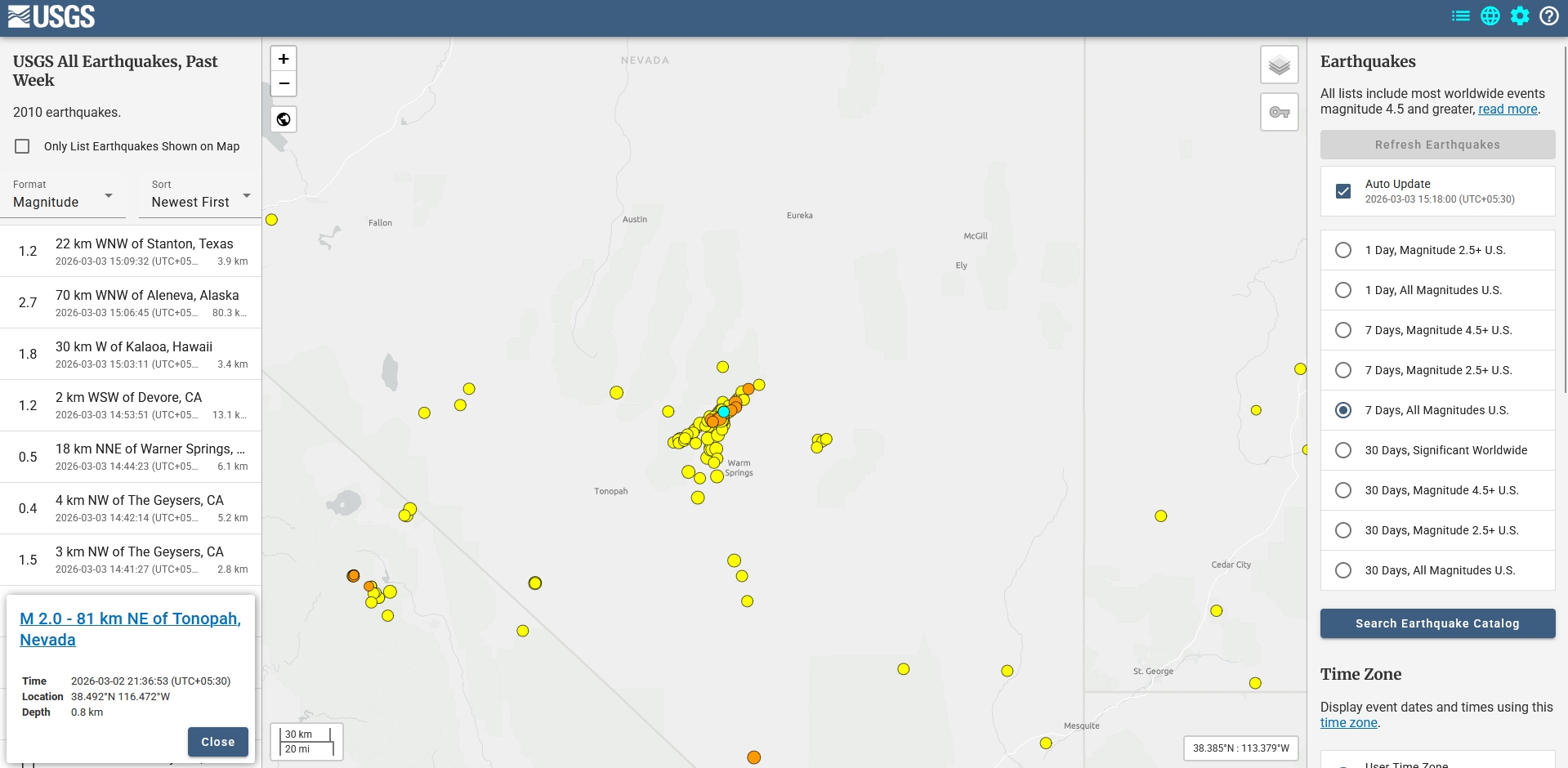
The earthquake swarm is centered within the Central Nevada Seismic Zone - a 200 to 300-mile-long north-south corridor running through central Nevada.
Geologists explain that this region is naturally prone to earthquake swarms because:
When stress accumulates along these smaller faults, it is often released in clusters of moderate quakes, typically under magnitude 5.0.
Nevada has a long history of underground nuclear weapons testing. While full-scale nuclear explosive tests ended in 1992 under a voluntary U.S. moratorium, the seismic signatures of underground explosions can resemble natural earthquakes.
Seismologists can distinguish between natural earthquakes and nuclear explosions by analyzing:
Natural earthquakes typically occur deeper underground and produce stronger shear waves. Nuclear detonations, by contrast, release energy closer to the surface. The USGS National Earthquake Information Center (NEIC) initially catalogs all seismic events similarly, but further analysis usually reveals whether a tremor was natural or explosive in origin.
At present, there has been no announcement of resumed full-scale nuclear testing in Nevada.
The recent earthquake swarm coincides with significant geopolitical developments:
Moreover, rising tensions with Iran including recent U.S. military operations have intensified public scrutiny around nuclear policy and weapons readiness.
In 2025, the National Nuclear Security Administration (NNSA) warned that the U.S. might need to restart weapons testing if geopolitical rivals expanded their nuclear programs.
Officials recently revealed that new containment devices were installed in underground Nevada labs to simulate microscopic nuclear explosions. These subcritical tests do not involve full-scale detonations but allow scientists to study nuclear weapon performance.
Area 52 has faced controversy in recent years. Former personnel have alleged exposure to radioactive materials during testing operations, claiming long-term health effects including cancer.
Historically, Nevada’s nuclear test sites have been linked to:
However, no official statement connects the current earthquake swarm to nuclear activities. While the timing of the earthquake swarm has fueled speculation, geological experts emphasize that:
Without definitive seismic evidence pointing to artificial detonations, the most plausible explanation remains natural tectonic stress release.
Final Thoughts
The mysterious earthquake swarm near Area 52 has reignited public curiosity about Nevada’s secretive military operations and nuclear history. Yet, despite geopolitical tensions and treaty expirations, there is currently no verified indication that the tremors are linked to renewed nuclear explosive testing.
As monitoring continues, scientists will analyze seismic data for deeper clues but for now, Nevada’s rumbling desert appears to be the result of natural geological forces rather than classified weapons activity.












Explore the USA's most iconic attractions, from historic landmarks to breathtaking natural wonders.